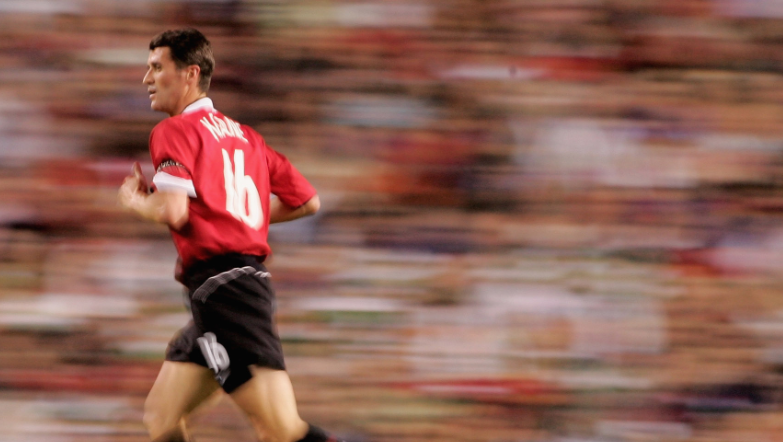
When Roy Keane appeared on the ITV documentary Keane & Vieira: Best of Enemies, the presenter Gabriel Clarke asked the former Manchester United captain about his old rival’s biggest strength; “he was tough”, said Roy. The next question (“what was his weakness?”) saw a brief moment of pause from Keane. “He wasn’t as tough as me”, came the answer. For many, that statement encompassed the illustrious career of one of the finest midfielders in recent times. Should the career of Roy Keane really be summed up by ‘toughness’?
There is no denying that Roy Keane was a ‘tough’ player. But would remembering that as the most notable aspect of his incredible career do him a great injustice? How big a part did it play in him becoming the most influential midfielder of his generation?
Perhaps the obvious show of strength of both body and character Keane displayed throughout his career overshadowed his ability with a ball at his feet. The Irishman has had a knack of underplaying his own talents, in the aforementioned documentary he compared praise for his performance in Turin, in 1999, to the same as thanking a postman for delivering the mail.
Did the game of football come so easy to Keane that a terrific performance, even by his standards, was seen to him as just doing the job he was paid for? More likely it is down to the breakdown in his relationship for Sir Alex Ferguson. After all it was Ferguson who lavished such praise on his captain after United reached the Champions League final in tremendous fashion. The deterioration in the relationship between the pair has obviously had an effect on Roy Keane. The toughness that defined Keane on the pitch has followed him off of it, particularly in retirement. Sir Alex’s criticism of him has given Keane a feeling of betrayal. They are similar characters and now they are no longer working for the same cause, those strong personalities have clashed.
It’s easy to see why people haven’t taken to Keane. He is fierce, outspoken and controversial. Those traits he learnt from the great Brian Clough, having witnessed the legendary manager in his final erratic years. Clough once punched Keane, knocking him to the floor, in the dressing room at half time. Keane harbours no ill feeling toward his former Nottingham Forest manager admitting, quite bizarrely, that he probably deserved it. But the aspects of Roy Keane’s character made him more than just a talented athlete.
He possessed a wonderful natural ability, he could pass, shoot, tackle, in other words he was the complete all-round footballer. Back in his younger days, he was equally adept at going forward as he was defending his own box. Roy Keane set the standard by which all central midfielders are measured. But he was more than that. He was a leader, a phenomenal influence on those around him both in his own team and the opposition, and he was a winner.
When he put on the red shirt all Roy Keane cared about was winning. He drove those around him to be better and intimidated those opponents who dared to challenge him. He could be reckless, brutal even, and he possessed an innate fierceness that frightened opposition as well as his teammates.
There were those who confronted him on the pitch. A threat to his command of a football pitch could cause Keane to reach new heights of controversy and brutality. None more so than his vicious foul on Alf-Inge Haland in the Manchester derby in 2001. The knee-high tackle was seen as Keane’s own handing out of justice, of revenge for a previous incident. When it came to battles, Roy Keane took an ‘eye for an eye’ approach.
Patrick Vieira was arguably his toughest opponent, their battles often helped decide title clashes between Arsenal and Manchester United. It was all about command and order and Roy Keane was a midfield dictator. As he said, Vieira was tough, but not as tough as Keane. Compare the trophies won and you can see the victor. Those matches were full of fire and hate, for all the graceful and technical brilliance on show, it was strength, courage and desire on which they were won. And Keane had all those qualities in abundance, he grew out of the hatred and although there were moments when he could way too far, you couldn’t take it away from him. That character won Manchester United titles. The famous ‘never-say-die’ spirit was an attitude which Keane subscribed to. Manchester United was the perfect club for him.
Even though his power eventually waned as his body became weakened from numerous injuries, the influence Keane held over Manchester United was significant. The victories and the glories were intertwined with his influence. They have never managed to replace him, his sort of character are no longer found in the modern game. Not one who possesses his ability anyhow.
Roy Keane was tough. And his bitterness at how his United career ended may cause him to undersell his ability. That is how he possibly likes to see himself but he was far more than that. Anyone who saw that remarkable match against Juventus in 1999 will remember seeing the ultimate display, not just from a midfielder, but from a professional athlete. Roy Keane might not accept such praise but whether he likes it or not, he certainly deserves it.
“It was the most emphatic display of selflessness I have seen on a football field. Pounding over every blade of grass, competing as if he would rather die of exhaustion than lose, he inspired all around him. I felt it was an honour to be associated with such a player.”
Sir Alex Ferguson on Keane’s performance against Juventus.



Comments.
Loading comments…