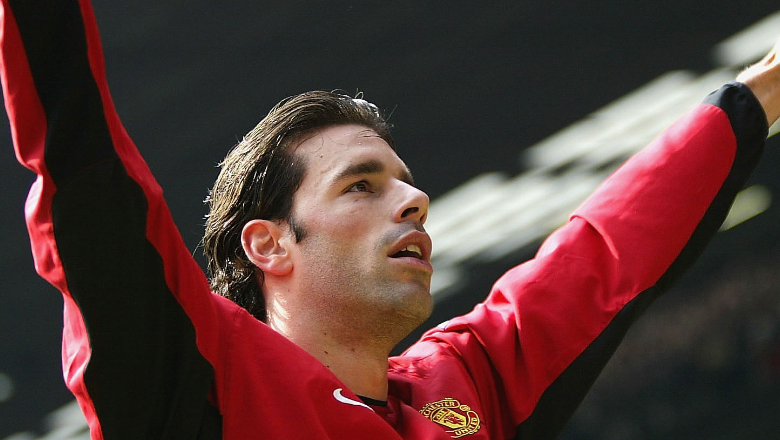
Ruud Van Nistelrooy, the Dutch striker famously known as the ‘hitman’ has been one of the greatest Manchester United strikers. Joining the Old Trafford side in 2000, he has been one of the deadliest finishers in the Premier League history since. His career at United was supposed to start in the 2000-01 season but was instead signed in the summer of 2001 over concerns about his fitness, having not played for a month due to problems with his knee.
He was then officially signed as a Manchester United player. Van Nistelrooy signed a five-year contract after passing his medical. He downplayed United’s £19 million investment to reporters, saying “The price is not heavy for me – it lifts me up because it means United have big confidence in me”. This statement of his had built some confidence in the fans as they knew that this is the person they needed up front.
Making his debut against rivals Liverpool in the FA Community Shield at the Wembley stadium, he showed a glance of his skill by scoring the only goal for the Red Devils in a 2-1 loss. He started his league campaign for United in a 3-2 win over Fulham at Old Trafford where went on to score 2 important goals of the game. He scored his 1st Premier League hat-trick against Southampton in a 6-1 hammering of the Saints. In total during his first season, van Nistelrooy scored 23 goals in 32 league games. He broke the record he shared with Mark Stein, Alan Shearer and Thierry Henry, by scoring in eight consecutive league games. He also scored 10 Champions League goals, and was named the PFA Players’ Player of the Year. Also he was named the Sir Matt Busby player of the year and was the top scorer in the Champions League and had the maximum number of assists.
The following season was indeed his best time in a Manchester United shirt as he finished as the top Premier League scorer with 25 goals in 34 games, with a goal on the final day against Everton earning him the Golden Boot ahead of Thierry Henry. His tally included three hat-tricks against Newcastle United, Fulham and Charlton Athletic. He also scored in each of the final eight games of the season as United won the title. Van Nistelrooy won the Premier League Player of the Season in 2003. He was accredited with spearheading the title win for United with a goal tally that was described as “astonishing”. After scoring 12 Champions League goals, he was named by UEFA was the best striker in Europe. This year he had achieved all the Premier League awards – Player of the year, goal of the year and the Golden Boot and had been the top scorer in the Champions League for 2 times in a row. After winning his 1st ever Premier League medal he had stated – “My ambition is to combine the best of No 9 and No 10, who is also a team player and creator.
Van Nistelrooy started the 2003–04 season by scoring twice in his first two league matches, which boosted his goals in consecutive games record to 10 matches in a row. In the 0–0 draw on 21 September 2003, later dubbed the Battle of Old Trafford, Van Nistelrooy was at the centre of one of the most infamous incidents of the Arsenal–Manchester United rivalry. After missing a last-minute penalty that would have won the game for United, Van Nistelrooy was attacked by Martin Keown, prompting a melee involving several players from both sides; five Arsenal players including Keown received various bans and fines, while the club itself received a record fine of £175,000. Earlier in the game, he had been fouled by Patrick Vieira, who was sent off for a second bookable offence. Vieira and his manager Arsène Wenger both accused Van Nistelrooy of cheating and stamping on Vieira, prompting a vociferous defence by Sir Alex Ferguson.On 27 September, he scored a hat-trick against Leicester City in a 4–1 victory. He scored his 100th goal for the club in a dramatic 4–3 victory over Everton on 7 February 2004. In the FA Cup fifth round derby against Manchester City, van Nistelrooy scored twice to help 10-man United win 4–2, and again scored twice in the quarter-final against Fulham as United came from behind to win 2–1. He scored a further two goals, including one penalty, in United’s victory over Millwall in the 2004 FA Cup Final.
Van Nistelrooy missed a large part of the 2004–05 season due to injury, but nonetheless scored a Champions League-best eight goals. One of them was his 30th career European goal, which he scored in a 2–2 Champions League group stage draw with Lyon on 16 September 2004, overtaking Denis Law’s previous club record of 28 goals. Law later said to reporters, “I’m delighted for Ruud. It could not happen to a nicer guy.” On 24 October, Arsenal returned to Old Trafford for another dramatic fixture. Arsenal entered the fixture with 49-game unbeaten run and had been dubbed The Invincibles, but United won the game 2–0. Van Nistelrooy scored the opening goal from the penalty spot, atoning for the penalty miss the previous year, with Wayne Rooney scoring a second. Van Nistelrooy was later banned for three games for a foul on Ashley Cole that the referee had missed. On 3 November, Van Nistelrooy scored all four goals in a 4–1 win against Sparta Prague. On 17 April 2005, he scored two goals in the FA Cup semi-final in a 4–1 win against Newcastle United, but United lost the final on penalties to Arsenal.
At the start of the 2005–06 season, Van Nistelrooy scored in United’s first four Premier League games. He finished as the second-highest league scorer with 21 goals, behind Arsenal’s Thierry Henry. However, he was benched for the League Cup Final against Wigan Athletic, fuelling speculation of a rift between him and Alex Ferguson, which Van Nistelrooy denied. He was nonetheless left on the bench for six consecutive league matches, and though he then returned to the starting line-up and scored match-winners against West Ham United and Bolton Wanderers, fresh doubt spread over Van Nistelrooy’s future when he was benched for United’s season finale win over Charlton Athletic. Ferguson claimed that Van Nistelrooy was angry at the decision and left the stadium three hours before kick-off. On 9 May 2006, it was reported that van Nistelrooy’s exclusion from the squad was due to a training session fight between him and team-mate Cristiano Ronaldo. Van Nistelrooy allegedly criticised Ronaldo’s tendency to hold onto the ball instead of passing to his team-mates, which sparked the fight, after which Van Nistelrooy remarked, “Go crying to your daddy.” Van Nistelrooy later apologised to Ferguson for his behaviour in the last few months.
Van Nistelrooy signed with La Liga side Real Madrid on 28 July, departing Old Trafford after five seasons with a total of 150 goals in 219 appearances, with his final goal coming on 1 April against Bolton. Wanderers, scoring what proved to be the winning goal. With 38 goals, he is also the club’s all-time European top goal scorer. Truly his time with Manchester United was a golden period for the club when it came to score goals. His departure was of course a very big loss to the Old Trafford side.





Comments.
Loading comments…