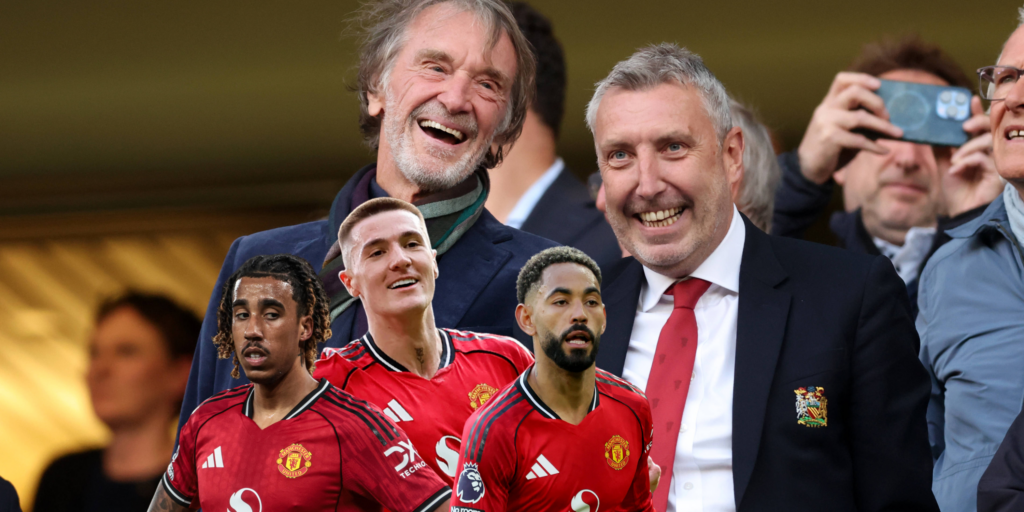

- Who are the best Manchester United signings under INEOS
- Who has topped the list?
- Who anchors it?
Manchester United have reshaped their squad under INEOS, with 12 signings marking the start of a new era at Old Trafford. Results have varied—some have settled instantly, others still search for rhythm—but the direction of travel feels clearer.
Whilst INEOS and Jim Ratcliffe have been rightly slated for many aspects of how they have run the club—ticketing being a key one—you must throw praise to them when it comes to recruiting, as practically all of their decisions have worked out so far.
Diego Leon has not been included, as he has yet to make an appearance for the club.
11 – Manuel Ugarte
Whoever finishes bottom often feels aggrieved—but can Manuel Ugarte genuinely have any complaints? The Uruguayan has shown flashes, certainly, but that spark has rarely translated into sustained influence. Inconsistency defines his body of work.
Ugarte’s latest outing typified the issue. In the 2-1 defeat to Leeds, he delivered one of the most laboured 45-minute displays seen in a United shirt this season.
Slack in possession, loose in execution—he coughed the ball up six times before the interval, completed just one tackle, and misplaced five passes. It was a performance devoid of authority.
Whilst there is a good player inside Ugarte, he seldom shows it. It is likely that the 25-year-old will depart the club in the summer.
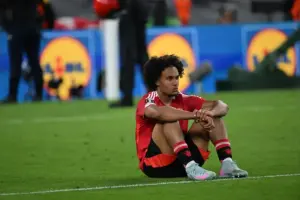
10 – Joshua Zirkzee
Joshua Zirkzee has offered glimpses, moments where you see the idea, but not enough to climb higher. Technically, he intrigues. For a 6ft 4in striker, he moves with rare elegance, gliding past defenders with soft touches and subtle shifts. There is an aesthetic quality to his play that draws the eye.
But aesthetics alone do not cement a place in the XI. He has had his moments. That slaloming dribble against Arsenal in the FA Cup—leaving William Saliba on the turf—still lingers in the memory. Yet moments remain sporadic.
More minutes under Michael Carrick could refine him, but the trajectory currently points towards a summer exit—if Manchester United find a suitable landing spot.
9 – Patrick Dorgu
If this ranking focused solely on Carrick’s opening games, Patrick Dorgu would sit far higher.
In those opening two matches, he produced performances of genuine incision—tearing into the sides, sitting first and second in the table. Goals against Manchester City and Arsenal, with the latter earning United’s Goal of the Month, underlined his impact.
Then momentum halted. A hamstring tear has sidelined him for close to three months, freezing that early surge. Before Carrick, his form fluctuated—flashes of quality punctuated by quieter spells.
The raw tools remain. Now it becomes a question of continuity—and how Carrick chooses to deploy him.
8 – Noussair Mazraoui
A few months ago, Noussair Mazraoui likely sat much higher in this list. Last season, he stood out in a side often devoid of rhythm. This campaign, his level has dipped.
There are still strong showings. In the 1-0 win over Chelsea, he slotted in at centre-back alongside Ayden Heaven and helped secure a clean sheet in a high-stakes fixture.
But inconsistency has crept in. Against Leeds, Carrick withdrew him after 70 minutes—and Manchester United immediately looked sharper.
Constant positional shifts have not helped. Under Amorim, he toggled between right centre-back and wing-back; under Carrick, he has reverted to a traditional full-back role that blunts some of his strengths.
Even so, his baseline remains solid. At this point in the list, you are passing the test.
7 – Benjamin Sesko
If we judged purely on Carrick’s tenure, Benjamin Sesko would rank far higher. But context matters.
United paid RB Leipzig £73.7 million for the Slovenian, and while he has delivered in bursts, there have been spells where supporters have questioned his overall impact.
Ten goals in 30 games this season tells part of the story. Break it down, and each goal has effectively cost £7.37 million—wages excluded.
In recent weeks, Sesko has carved out a niche as a bona fide super-sub. ‘Ole Gunnar Sesko’, if you will.
There is still refinement required. His close control throughout full matches must improve, and he needs to better recognise when to act ruthlessly. He thrives in moments that demand instinct—his goal against Fulham exemplifies that—yet hesitates when afforded time, as seen in his decision to pass to Matheus Cunha against Aston Villa rather than shoot.
Sesko remains young. There is ample time for him to evolve into a more complete forward.
6 – Matthijs De Ligt
At the beginning of the season, Matthijs De Ligt arguably stood as United’s standout performer. Now, he has been absent for close to five months.
Initially expected to miss only a week, his prolonged absence has raised legitimate concerns. When fit, however, he was imperious. Commanding, composed, and consistently delivering authoritative displays at the heart of defence.
There is also a curious footnote to his career: since making his debut for Ajax in 2016, he has started every professional season under a different manager.
De Ligt and Martinez form a natural partnership, but I would like to see him share more minutes with Ayden Heaven. Across their time together, they have played just 261 minutes—a pairing that could yet prove invaluable, particularly from a mentorship perspective.
Still, durability now becomes a question that cannot be ignored.
5 – Ayden Heaven
Ayden Heaven’s limited minutes under Carrick—just 15 prior to the Chelsea fixture—might suggest a lower placement. But his impact, relative to cost, elevates him.
Signed for a mere £1 million, he has already exceeded expectations. Thrown into the first team amid a defensive injury crisis under Amorim, the 19-year-old did not shrink. Instead, he asserted himself immediately.
Opportunities have remained scarce, which is understandable given the competition: Martinez, Maguire, Yoro, and De Ligt. Yet when called upon, he has delivered.
His growing connection with Yoro is particularly intriguing. The pair have even travelled together for specialised training sessions in Dubai—an indication of both their commitment and chemistry.
With a combined age of just 39, they represent the defensive future of this club.
4 – Leny Yoro
As already mentioned, Leny Yoro is the centre-back of the future for Manchester United. Excelling at covering space in behind the defensive line, the Frenchman continues to refine his game, growing more assured both on the ball and in his reading of it.
Partnered alongside any of United’s current defensive options, Yoro tends to thrive. When paired with a more aggressive centre-back—think Martinez or Maguire—he looks particularly composed, able to sweep up danger and operate with a sense of control.
One of his standout traits comes in those split-second moments. Whether it is a recovery run or a foot race, Yoro relishes those duels, often matching attackers stride for stride.
There have been moments, however, where his rawness has surfaced.
Against Southampton in January 2025, Kamaldeen Sulemana gave him a torrid afternoon, repeatedly isolating him and breezing past him with relative ease for large stretches of the match before Yoro was eventually withdrawn in the 83rd minute.
Since then, he has shown far greater restraint. No longer does he dive into challenges or overcommit in dangerous areas, instead opting for a more measured, composed approach.
Within five years, he could very well cement himself as United’s starting centre-back—and if his trajectory continues, even grow into a future captain.
3 – Bryan Mbeumo
Until maybe a month ago, there was simply no way to displace Bryan Mbeumo from the top of this list. But in recent weeks, his form has dipped, and if that trajectory continues, he will only keep sliding further down.
Prior to the African Cup of Nations, Mbeumo was an electric presence in the Manchester United side, a constant outlet with almost every attacking move funnelling through him. Not only was he scoring, but he was also crafting key moments, driving the tempo, and influencing matches from start to finish.
He felt indispensable. Since returning, however, that sharp edge has dulled.
Yes, he still managed to score against Manchester City and Arsenal, but across those matches his overall involvement was noticeably reduced. He no longer dictated play in the same way, nor did he carry that same attacking menace throughout the full 90 minutes.
And since then, the output has dried up even further.
Across the ten matches that followed, Mbeumo started all but one, yet found the net just once—in United’s 2-0 win against Tottenham Hotspur.
With the season drawing to a close, there is perhaps a silver lining. Mbeumo has been exceptional for large stretches, but he looks like a player in need of a reset.
With Cameroon not participating in the 2026 World Cup, he will have the opportunity to step away, recharge, and return next season with that same verve that once made him undroppable.
2 – Matheus Cunha
It may have taken Matheus Cunha a few weeks to properly get going, but now that he has found his rhythm, it is easy to see why United invested so heavily in the Brazilian.
Scoring his first goal nine matches into his Manchester United career raised a few eyebrows, and there were early concerns around his output.
Even then, though, his overall performances remained strong. He influenced games, linked play well, and consistently looked dangerous, even if the numbers were not immediately there.
Now, they are starting to follow. Eight goals and four assists might not scream elite at first glance—especially when compared to his numbers at Wolves last season—but the context tells a far richer story.
Cunha has delivered in the moments that matter. Goals against Arsenal, Aston Villa, and Chelsea, combined with assists against the likes of Manchester City, underline just how decisive he has been. He has not just contributed—he has shaped results.
His now-signature wave celebration, performed twice in London following match-winning goals, has already become part of his identity among the fanbase.
Beyond that, his all-round game has been outstanding. Direct, inventive, and relentlessly engaging on the ball, Cunha gives United a different dimension in attack.
With Champions League football looming next season, he will now have the platform to bring that flair—and that celebration—to a wider, European stage.
1 – Senne Lammens
Is it too early to place Senne Lammens at number one on this list? I do not think so.
Since arriving at Manchester United on 1 September for a fee of £18.1 million, he has quietly, yet profoundly, elevated the entire side.
Let’s be clear—he has not come in and produced a catalogue of world-class saves, nor has he racked up an endless stream of clean sheets. But what he has done might be even more important. He has brought calm.
There is no longer that sense of unease when the ball gets played back to the goalkeeper. No sharp intake of breath from the stands, no lingering fear that something might go wrong.
Lammens settles everything. At just 23 years of age, the Belgian shot-stopper is still relatively young for a first-choice goalkeeper. Typically, players at that age continue developing, often serving as understudies to more experienced figures.
Lammens, however, has defied that pathway. After just one full season as Antwerp’s number one, he made the jump to one of the biggest clubs in world football—a move many expected might overwhelm him.
Instead, it seems to have sharpened him. He has handled the pressure with composure well beyond his years, delivering consistently assured performances throughout the season.
Now, the conversation has shifted entirely. It is no longer about who should start in goal—it is about who is good enough to sit behind him.
And that, more than anything, underlines just how impactful he has been.

Comments.
Loading comments…