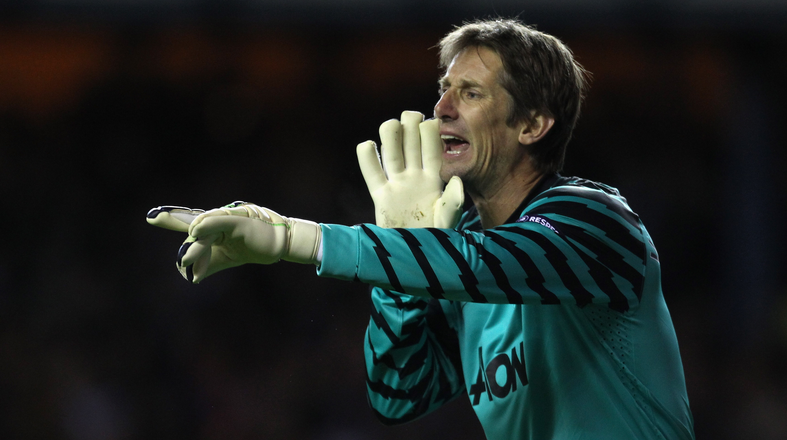
Goalkeepers have always been at the forefront of Manchester United’s title-winning teams, providing a solid backbone from which the rest of the team can depend on. Over the years, we have seen some incredible players grace Old Trafford with their special talents, winning games by themselves and inspiring legions of fans around the world. Here’s a look at some of the greatest keepers ever to don the United kit.
Harry Gregg (247 appearances, 1957-66)
Perhaps one of the best keepers never to win a medal whilst playing for United, Gregg joined the Reds in 1957 from Doncaster Rovers for a fee of £23,000, a world record for a goalkeeper at the time.
Gregg was considered first choice throughout his time at United, and he is rated by many to be the best goalkeeper that United have ever had at the club. Despite keeping 48 clean sheets for the Reds, Gregg never managed to win a medal for the club. He did not play in the 1963 FA Cup final due to a serious shoulder injury, and a multitude of injuries meant that he did not play enough games to gain a winners’ medal in the 1964-65 and 1966-67 seasons.
He earned 25 caps for Northern Ireland, playing in the 1958 World Cup and impressing in his four appearances to be named as the best goalkeeper of the tournament.
However, his goalkeeping heroics will be forever overshadowed by an act of incredible human spirit. Gregg survived the Munich disaster, which claimed the lives of many of his teammates, and showed great bravery in rushing back to the plane and saving his teammates, including Bobby Charlton, Jackie Blanchflower and Dennis Viollet. He also saved the lives of Vera Lukic, the pregnant wife of a Yugoslav diplomat, her daughter Vesna and manager Sir Matt Busby, who had suffered severe injuries, giving him the nickname the ‘Hero of Munich’.
Jimmy Rimmer (46 appearances, 1963-74)
Jimmy Rimmer may be the most unfortunate keeper to have ever played for United. Making only 34 appearances for the Reds, his pathway to the number one position between the sticks was blocked by the great Alex Stepney, who kept hold of the position for the best part of the next decade. However, some considered Rimmer to be an even better keeper than Stepney.
Rimmer served as the understudy to Stepney during United’s 1968 European Cup victory, and spent 11 years at Old Trafford, before moving on loan to Swansea in 1973. He impressed so much during his loan spell that Arsenal soon swept in and signed Rimmer in February 1974, as a replacement for Bob Wilson.
He was Arsenal’s first choice keeper for the best part of three years, during which he earned his solitary England cap in a friendly against Italy. After Terry Neil took over at Arsenal, Rimmer was made surplus to requirements and sold to Aston Villa, where he once again was the undisputed first choice keeper. He won the First Division title in 1981, and went on to win another European Cup the following year, with Villa beating Bayern Munich in the final. However, lady luck failed to shine on Rimmer, who, after playing just nine minutes, picked up an injury and had to watch on as Peter Withe scored the goal to give Villa the European Cup.
Alex Stepney (566 appearances, 1966-78)
Stepney was signed by Sir Matt Busby from Chelsea for a fee of £50,000, after deciding that Pat Dunne or the injury-prone David Gaskell were not up to the standards of becoming the first team keeper for the Reds. With the signing of Stepney, Sir Matt Busby had the completed the team that would win the European Cup in 1968.
Stepney
He was in goal as United won the First Division in 1966-67, which gained them entry into the European Cup. He was prevalent throughout United’s run to the final, where they would face Portuguese giants Benfica at Wembley. With the score at 1-1 during the closing stages, the great Eusebio struck a vicious close-range shot at goal. Stepney was equal to it, and made an astonishing save. Eusebio was so astonished by the save that he stopped to applaud him as he threw the ball back into play. United won 4-1 in extra time, and Sir Matt Busby had reached the promised land – winning the European Cup ten years after the Munich disaster.
Stepney continued to be the first choice keeper for United in the 70s, as the Reds went into a period of significant underachievement, culminating in relegation to the Second Division in 1973-74. Strangely, during that season, Stepney was joint top scorer at Christmas, having scored two penalties. With Tommy Docherty, Stepney’s former manager at Chelsea, now in charge, United bounced straight back, winning the Second Division at the first time of asking.
Once they bounced back however, Stepney was beginning to age, and had to compete with Paddy Roche for the starting position. However, he still managed to win an FA Cup medal in 1977, as United beat a strong Liverpool side who were chasing an unprecedented treble, with Stepney making some terrific saves.
Stepney made the last of his 566 appearances for United in April 1978, before leaving for Dallas Tornado in the North American Soccer League in the US, where he saw out his career before retiring in 1980. Keeping 175 clean sheets for the Reds, he will be forever remembered as one of United’s great keepers.
Peter Schmeichel (393 appearances, 1991-99)
Schmeichel was signed by Sir Alex Ferguson from Danish club Brøndby for a fee of £505,000, which Sir Alex later described as the “bargain of the century”. At the time, Schmeichel was a relative unknown outside of Denmark, where he had been the undisputed first choice for club and country. However, his performances for United would soon changed all that, as he became one of the best keepers to ever play for the Reds and perhaps, of all time.
In an eight-year spell at United, Schmeichel won five Premier League titles, three FA Cups, one League Cup and a Champions League. In his debut season, Schmeichel helped United finish second in the league and win the League Cup for the first time in their history, but it was on the international stage that Schmeichel earned his biggest success that year. Schmeichel was Denmark’s first-choice keeper as they shocked the world to win Euro 92, making a string of important saves as the Danes beat Germany in the final.
Schmeichel was an imposing presence in the United backline, as he was often seen barking orders to his defenders. He was also not afraid to go up and attack on corner kicks if United were behind. The sight of the big Dane was a huge distraction to many opposition defenders, and famously Schmeichel scored a last minute header against Rotor Volgograd in a UEFA Cup tie in 1995, although United were knocked out on the away goals rule.
Schmeichel will always be remembered for his contributions to the 1998-99 Treble winning season. In the FA Cup semi-final, Schmeichel saved a penalty from Arsenal’s Dennis Bergkamp in the last minute of the game to send it into extra time, where Ryan Giggs scored his stunning solo goal. Schmeichel then captained United in the absence of the suspended Roy Keane in the Champions League final on that famous night in Barcelona, where injury time goals from Teddy Sheringham and Ole Gunnar Solskjaer helped United complete the treble. Schmeichel played a role in Sheringham’s equaliser, running up for the corner to cause confusion in the Bayern Munich defence.
The Dane left United at the conclusion of that Treble winning season, and the rest of his career consisted of spells at Sporting Lisbon, Aston Villa and Manchester City before retirement in April 2003. However, it is his career at Old Trafford that will forever stick in the memory, as he was one of the backbone for United’s sustained success during the 90s.
Edwin van der Sar (266 appearances, 2005-11)
Sir Alex Ferguson had failed to fill the sizeable gap left in goal after Peter Schmeichel’s departure from the club, with Mark Bosnich, Massimo Taibi, Raimond van der Gouw, Fabien Barthez, Tim Howard and Roy Carroll all failing to fill the big Dane’s boots.
This all changed when van der Sar joined the Reds in June 2005 from Fulham for a reported £2 million fee, and Sir Alex had finally found a successor to Schmeichel. The Dutchman provided a reliable presence in goal, and numerous records were broken during his six-year spell at Old Trafford.
van der Sar went 1,311 minutes without conceding a goal during the 2008/09 season, breaking a Premier League milestone. He also became the first non-British player to continue playing in England’s top flight after his 40th birthday, as well as the first goalkeeper to keep 50 clean sheets in the Champions League. During his time at Old Trafford, he won four Premier League titles and two League Cups, with Sir Alex describing him as the best goalkeeper to have played for United since Schmeichel.
And who could ever forget Moscow 2008, the defining moment of van der Sar’s United career. Moments after John Terry’s slip, van der Sar palmed away Nicolas Anelka’s penalty to hand United their third European Cup at the Luzhniki Stadium. In total, van der Sar made 266 appearances for United before retirement in 2011, and despite bowing out with a Champions League final defeat against Barcelona, there can be no doubt that van der Sar has been United’s best goalkeeper of the last 15 years, and rightfully deserves a place among the pantheon of great keepers to have stepped foot on the Theatre of Dreams.
David de Gea (175 appearances, 2011-present)
De Gea joined the Reds in June 2011 from Atletico Madrid for a fee of around £17.8 million, a British record fee for a goalkeeper. Despite an uncomfortable start in the Premier League, De Gea has transformed into one of the Premier League, if not one of the world’s top goalkeepers at the moment, with Atletico’s city rivals Real desperate to lure him back to Madrid in what is certainly going to be one of the transfer battles of the summer.
It wasn’t all smooth sailing for De Gea when he first arrived at Old Trafford. He initially struggled to adapt to the British game, especially when crosses came into the box. It was a more physically environment than in La Liga, and De Gea looked especially vulnerable when he was pressured. At one point, he was even dropped in favour of Anders Lindegaard when he failed to claim a cross that led to a Grant Hanley goal for Blackburn Rovers in a game that eventually finished in a 3-2 defeat for United.
However, he has gone from strength to strength since that day. Former goalkeeping coach Eric Steele played a huge part in De Gea’s development. Learning Spanish in order to communicate with him, Steele focused on improving De Gea’s physical conditioning, making him bigger and stronger in order to deal with crosses effectively. This, coupled with his already impressive reflexes, would eventually see De Gea come of age and become a top quality keeper.
Currently, De Gea only has a solitary Premier League title among his medals at United, but his individual contributions have been recognised by his peers, as he has been voted in the PFA Team of the Year twice and been United’s Sir Matt Busby Player of the Year and the Fans’ Player of the Year for the past two seasons. It could be said that without De Gea between the sticks, United might well be in a poorer position, and he deserves a place among United’s great keepers.
De Gea might well be leaving the club this summer, with Real sniffing around, but if he stays, he could have a lasting impact on the Theatre of Dreams, and his place among the pantheon of United goalkeeping legends would be strengthened. Fans would certainly like him to do so and stay.
De Gea might well be leaving the club this summer, with Real sniffing around, but if he stays he could have a lasting impact on the Theatre of Dreams, and his place among the pantheon of United goalkeeping legends would be strengthened. Its certainly something that the fans and players alike would love to see!

Comments.
Loading comments…