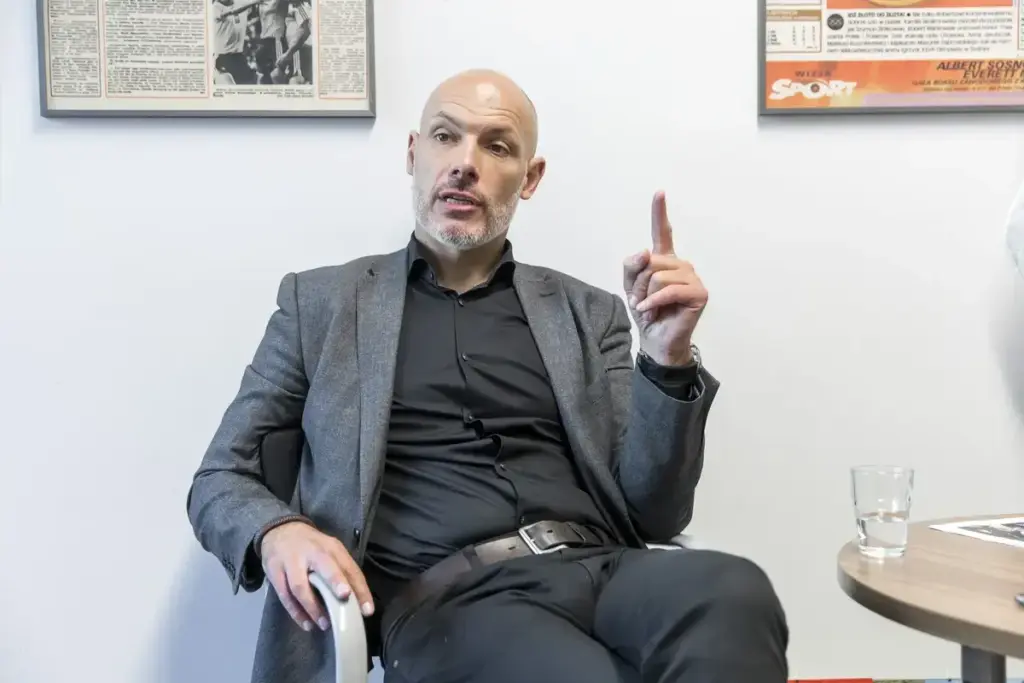

Manchester United have received a rare and unambiguous admission from the top of English refereeing: a goal that stood against them should never have counted. Pro Ref chief Howard Webb has confirmed that Erling Haaland’s goal was allowed to stand because of a VAR breakdown, one he has since labelled “tunnel vision” inside the review booth.
A Disallowed Goal That Stood: Howard Webb’s High-Stakes Admission
The sequence itself looked, in real time, like a routine offside call gone right. The assistant’s flag went up, Haaland was initially ruled offside on the pitch, and United’s defence relaxed accordingly. What followed was a VAR review that corrected one error while creating another, arguably more damaging one.
Webb did not hedge when addressing the outcome. “This goal should have been disallowed,” he said, a statement that leaves no room for ambiguity about where responsibility lies. He went further, explaining the basic sequence of events that United fans had been demanding clarity on since the final whistle. “We felt it was important that we acknowledged an error in the situation. We know that Erling Haaland was penalised for offside and wasn’t in an offside position,” Webb said.
That much was true, and it is precisely why the review process exists. The problem, as Webb went on to detail, is that correcting one offside judgement while ignoring another is not a correction at all.
How ‘Tunnel Vision’ Blinded VAR to Enzo Fernandez’s Offside Position
The heart of the failure sits with Enzo Fernandez, whose positioning was central to the passage of play but was never properly assessed once the review focused on Haaland. Webb was explicit about the missed context. “We also know that Enzo Fernandez, who was in an offside position, almost certainly interfered with the Manchester United defence and probably the goalkeeper,” he said.
That distinction matters enormously under the offside law. A player in an offside position does not need to touch the ball to be penalised; interference with an opponent’s ability to play the ball, or with the goalkeeper’s line of sight, is enough. Webb’s account suggests that Fernandez’s presence affected exactly those factors, yet the review never reached that stage of analysis.
Explaining how that happened, Webb described a VAR operator who became fixated on a single element of the phase. “The VAR gets super focused on Haaland. He establishes he is onside but when he runs it through the full APP, he doesn’t truly evaluate the full impact of Fernandez,” he said. The Attacking Phase of Play protocol exists specifically to guard against this kind of narrow focus, checking every offside body in a passage rather than just the goalscorer. On this occasion, according to Webb, it did not function as designed.
Webb’s language was pointed rather than defensive. “In that moment, he gets tunnel vision but it is down to the rest of his team to pull him out of that tunnel but unfortunately, that did not happen on this occasion,” he said. It is an admission that the safeguard built into VAR working practices, a support team checking the lead official’s blind spots, broke down at the moment it was needed most.
Three Centimetres Onside: Breaking Down the Flawed Attacking Phase Protocol
Much of the post-match debate had already centred on the marginal nature of the Haaland offside line, and Webb’s explanation confirms why that measurement dominated attention. VAR established that Haaland was onside by three centimetres, a margin tight enough to justify the technology’s involvement in the first place. That part of the process worked exactly as intended.
The failure was not in measuring Haaland’s position but in what happened immediately afterwards. Once Haaland was confirmed onside, the Attacking Phase of Play check should have continued through every other player in an offside position during the buildup, assessing whether any of them interfered with United’s defenders or goalkeeper. Webb’s account makes clear that this second stage of the process was effectively skipped, with Fernandez’s involvement never subjected to the scrutiny it required.
For a system designed with layered checks specifically to prevent this outcome, the sequence represents a procedural gap rather than a one-off human misjudgement. Webb’s willingness to name the exact protocol that failed, rather than offer a vaguer explanation, gives United and their supporters a precise account of where accountability sits.
Pro Ref Accountability and What the Stood-Down Officials Mean for Man Utd
Beyond the explanation itself, Webb outlined the concrete steps Pro Ref took once the mistake was identified. The organisation reached out directly to Manchester United, acknowledged the mistake and shared both the audio and video from the VAR review with the club, giving United’s hierarchy full access to how the decision unfolded in real time.
Webb was candid about the mood inside Pro Ref in the aftermath. “I was really disappointed with this outcome; we all were. None more than the officials. They take personal pride in what they do and they are hurting now after falling short in this situation. They will not be officiating until after the international break,” he said.
That confirms a temporary stand-down for the officials involved rather than any longer-term sanction, and Webb’s comments should not be read as signalling further disciplinary action beyond that point. For United, the value of this episode lies less in the suspension itself than in the transparency of the process: a senior figure at Pro Ref naming the specific technical failure, rather than issuing a generic statement of regret. Supporters can revisit the initial reaction to the goal itself via Man Utd Derby: Pro Refs Admit Error in Erling Haaland Goal, while the full detail of Webb’s comments is available in the Sky Sports report on Howard Webb VAR admission.
What happens next rests on whether Pro Ref’s admission translates into a tightened Attacking Phase of Play process, one that cannot be undone by a single official’s tunnel vision without a colleague catching the gap. United will take some comfort from the acknowledgement; whether the sport’s officiating structures actually close that loophole is the question this episode leaves open.



Comments.
Loading comments…