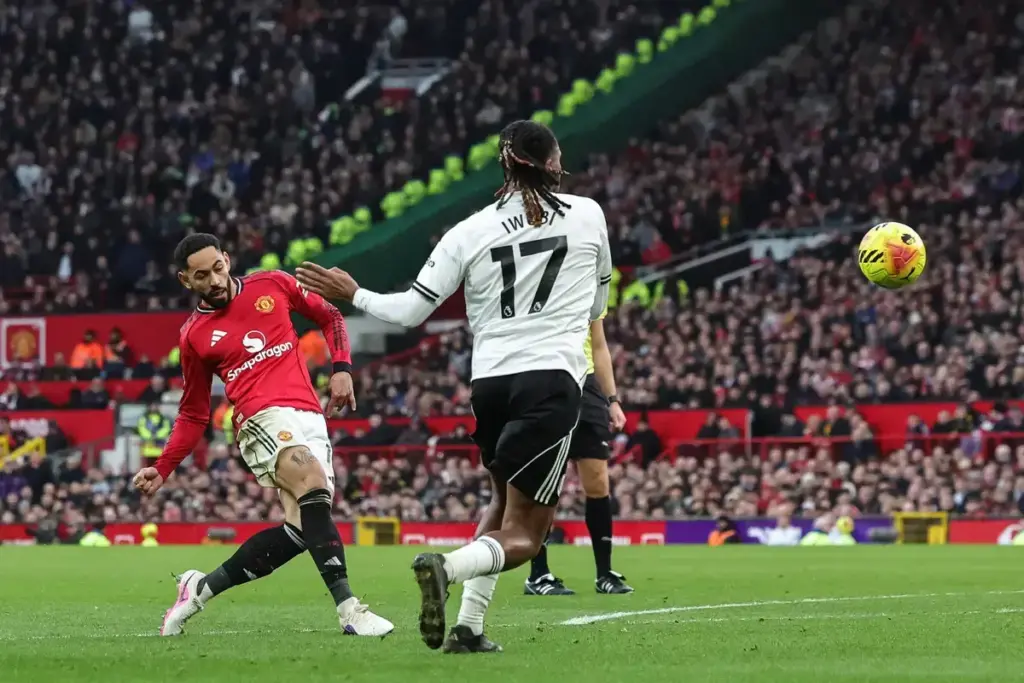

Michael Carrick’s Manchester United left Craven Cottage with a point, not three. They drew 1-1 with Fulham in the Premier League on 20 September 2026. Lisandro Martínez’s 63rd-minute own goal put Fulham ahead. It looked like it might be enough. Then Matheus Cunha struck in the 89th minute to rescue a point for the visitors.
The scoreline only tells part of the story. This match offered a clear look at how Carrick wants his side to build, defend and attack. Senne Lammens deputised in goal. A reshaped midfield pivot sat in front of him. Against a well-organised Fulham side, it was a real test of the manager’s evolving structure. Here is a full tactical breakdown of the key patterns from the match.
Expected Goals (xG) & Advanced Data Analysis
Detailed shot-quality data from Craven Cottage was not available from official tracking sources at the time of writing. This analysis focuses instead on the tactical mechanics that shaped the contest. Neither side dominated territory for long. Control shifted depending on which team won the ball in midfield, and that pattern held for most of the ninety minutes.
Fulham’s opening goal did not come from sustained pressure. Martínez’s own goal in the 63rd minute arrived from a move United had, for the most part, contained. It changed the complexion of the match far more than the balance of chances up to that point suggested it should. That is a familiar pattern in tight Premier League fixtures. A single moment can outweigh long periods of even football.
United’s response after going behind showed a clear rise in field tilt, the share of play spent in the attacking third. Carrick’s side committed more bodies forward. Bruno Fernandes and Bryan Mbeumo both looked to operate between the lines. Marcus Rashford stretched Fulham’s back line from the left. That sustained pressure eventually bore fruit. Cunha found the net in the 89th minute, and the goal reflected United’s growing control in the closing stages rather than a moment out of nothing.
United had an even opening period. Fulham then broke the deadlock against the run of play. United answered late, through a goal built from sustained pressure rather than a single chance. Each of those phases had a distinct tactical cause, and each is worth examining in turn.
Lesson 1: Buildup Dynamics and Pressing Resistance
Carrick set his side up with Kobbie Mainoo and Youri Tielemans forming a midfield pivot in front of the back four. Their job was to help United play through Fulham’s press, not around it. Lammens was regularly the first point of contact in these sequences. He used short passes to Harry Maguire and Martínez to draw Fulham’s forward line out of position, buying time for the pivot to find angles further up the pitch.
Mainoo tended to drop slightly deeper to receive from the centre-backs. Tielemans looked to break lines with progressive passes into the half-spaces once Fulham’s midfield had committed to the press. When Fulham’s front players jumped to close down United’s centre-backs, gaps opened between their midfield and defensive lines. Mainoo and Tielemans looked to exploit those gaps whenever they appeared.
Fulham’s own pressing structure was built around Josh King and Alex Iwobi leading the line. It was organised enough to force United into occasional long clearances, particularly in the first half. Sander Berge and Shea Charles worked hard to cut passing lanes into midfield. There were spells where United’s buildup stalled completely, and possession was conceded in dangerous areas as a result.
Still, the underlying pattern favoured United across the ninety minutes. Once Mainoo and Tielemans found their rhythm, United bypassed Fulham’s initial press with greater consistency. They fed Fernandes and Mbeumo in pockets of space closer to Zone 14. That territorial progress laid the groundwork for the pressure United applied in the closing stages. The reward did not always arrive straight away, but the pattern was clear and it held up under scrutiny.
What stood out most was patience. Rather than force long balls forward when the press arrived, United’s centre-backs and goalkeeper kept circulating possession. That discipline cost them territory at times. It also meant Fulham’s press had to work hard for ninety minutes, and by the closing stages that effort had clearly told on Fulham’s legs and organisation.
Lesson 2: Rest-Defence Structure and Midfield Transitions
Rest-defence is the defensive shape a team holds while it has the ball. It was a defining theme of this match. Full-backs Diogo Dalot and Luke Shaw both pushed forward to support United’s attacking phases. That left Martínez and Maguire as the two spare central defenders. Mainoo or Tielemans dropped in to offer additional cover whenever the situation called for it.
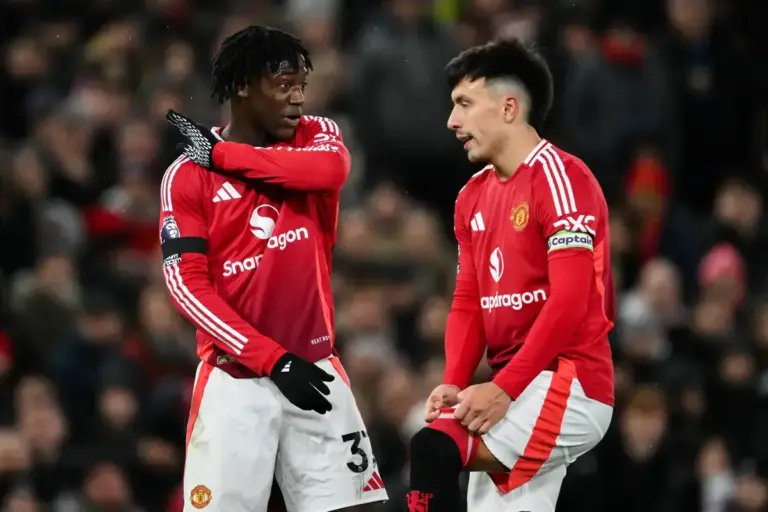
That structure was tested directly in the build-up to Fulham’s goal. Martínez’s own goal came during a passage where United’s rest-defence shape was not fully set. It left the Argentine exposed to a deflection he could not avoid. This was a moment of misfortune rather than a structural failure. It did, however, show how quickly the picture can change when a team commits numbers forward against opponents who can transition at pace.
Fulham looked to use Gonzalo García and Iwobi as main options on the counter. Their aim was to catch United before their rest-defence could reset. Timothy Castagne and Antonee Robinson supported these transitions from full-back, overlapping quickly whenever Fulham won the ball back in central areas. United’s response was to have Tielemans screen the space directly in front of the back line. He performed that role with increasing discipline as the match wore on.
By the second half, United had tightened their transition defending considerably. They limited Fulham’s ability to break at speed, even after taking the lead. That improvement mattered a great deal. It allowed Carrick’s side to commit more players forward in search of an equaliser, without leaving themselves exposed to a second Fulham goal on the counter. Supporters looking for wider context on how the performance was received should read our reaction to the Fulham performance, which examines how pundits assessed Carrick’s approach after the final whistle.
There was a clear trade-off at play throughout. Every extra body United sent forward reduced their cover at the back. Carrick appeared willing to accept that risk once Fulham led, and the balance shifted visibly after the hour mark. Fulham had fewer clean counter-attacking opportunities in the final third than the scoreline alone might suggest, and United’s willingness to reset quickly deserves credit for that.
Lesson 3: Wide Rotations and Late Final-Third Penetration
United’s most productive attacking spells came through rotations on the flanks. Mbeumo and Rashford regularly interchanged positions to unbalance Fulham’s back line. Mbeumo’s tendency to drift infield created space for Dalot to overlap on the right. Rashford’s movement inside allowed Shaw to threaten the byline on the opposite side, stretching Fulham’s defensive block from both flanks at once.
Fulham’s wide defenders, Castagne and Robinson, had constant decisions to make. Should they track these rotations, or hold their defensive line? Oscar Bobb and Iwobi were not always able to offer consistent tracking support in behind. That uncertainty gave United’s front line room to operate in the half-spaces. It grew more pronounced as the match wore on, particularly once Fulham’s press began sitting deeper to protect their lead.
Cunha’s role was central to United’s late improvement in the final third. Operating close to Fernandes, he offered a runner in behind whenever United worked the ball into wide areas. That movement ultimately proved decisive. His 89th-minute equaliser came from exactly the kind of final-third penetration Carrick’s side had been building toward for much of the second half. It arrived after sustained pressure through the wide areas, not as an isolated chance out of nothing.
The goal also reflected United’s willingness to keep committing players forward, even after Fulham’s lead had held for over twenty minutes. Fernandes, Mbeumo and Rashford all stayed advanced. They maintained the field tilt that had built steadily since Martínez’s own goal. That collective positioning created the space Cunha needed to finish. Several of the match’s key moments, including the goal itself, were shaped by refereeing calls that drew scrutiny afterwards. Readers can find a full breakdown of the key refereeing decisions at Craven Cottage for further context on those flashpoints.
What made the equaliser satisfying, beyond the result, was its construction. United did not rely on a set piece or an individual moment of brilliance. They built it through repeated wide overloads, patient circulation, and a runner arriving on cue. That kind of goal tends to reflect a coherent attacking plan rather than luck, and it is the clearest evidence from this match that Carrick’s principles are starting to bed in.
Taken together, the three lessons from Craven Cottage point to a United side still refining its identity under Carrick. The buildup patterns through Mainoo and Tielemans showed genuine progress against a well-drilled Fulham press. The rewards were not always immediate, but the process held up. The rest-defence structure survived an unfortunate own goal reasonably well. The wide rotations that produced Cunha’s equaliser suggest Carrick’s attacking principles are beginning to translate into results, even when a full three points prove elusive.
A draw away from home against a competitive Fulham side is not a disastrous outcome. The manner of the goals, one conceded, one scored, will still give Carrick plenty to work with on the training ground before United’s next fixture. The structural foundations look sound. Converting territorial control into a cleaner scoreline, more consistently, is the next challenge facing this United side.






Comments.
Loading comments…