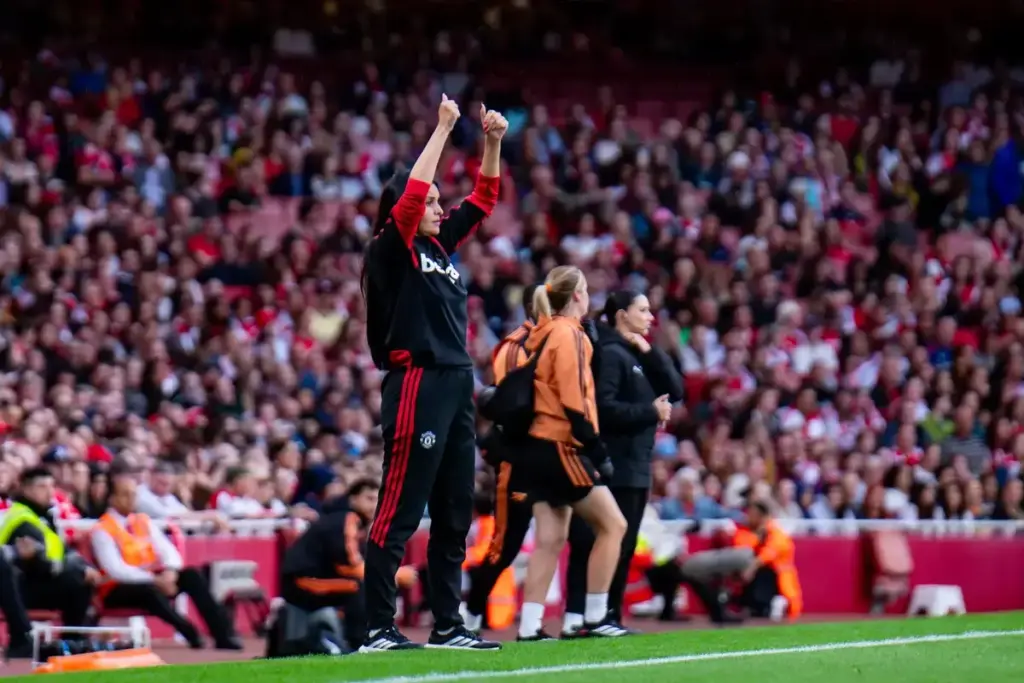

Eva Olid took the Manchester United job with a reputation built at Hearts, where her sides pressed high and kept the ball for long spells. Three WSL games into her reign at Old Trafford, the pattern looks very different. This Eva Olid tactical breakdown examines why United have had far less of the ball than their opponents in each of her first three WSL games in charge, and what that tells us about a side still learning a new way of playing. It is early days, but the shape of the problem is already visible.
Expected Goals (xG) & Advanced Data Analysis
Possession numbers rarely tell the whole story on their own, but conceding the majority of the ball in every one of Olid’s first three league games is low enough to demand an explanation. Olid built her name on the opposite approach at Hearts, where patient circulation and control were the calling cards. At United, her side have spent far more time without the ball than any previous version of this squad under Marc Skinner.
That does not automatically mean United are being outplayed. A team can sit deeper, invite pressure, and still generate the better chances on the counter. But it does mean the structural principles Olid wants to instill, patient build-up, central combinations, players finding pockets of space, are being tested in matches where United rarely have the platform to use them for long.
The honest picture is one of transition. Three league fixtures are not enough to draw firm conclusions on shot quality or chance creation, and we will not pretend to know exact underlying numbers that have not been verified. What we do know is the possession share, and it points to a team still adjusting to a system that asks a lot of its passers under pressure.
Lesson 1: Rest-Defence and the 4-2 / 3-2 Build-Up Mechanics
The clearest change under Olid is structural. Skinner’s United built from a 3-2-2-3 shape, with wide centre-backs stepping into midfield lanes and width provided high up the pitch. Olid has moved to a 4-2 or 3-2 base, with her two central midfielders forming a narrow double pivot rather than spreading across the pitch.
This is a deliberate rest-defence choice. Keeping the pivot narrow and central is meant to protect the middle of the pitch if possession is lost, and it gives United a compact base to spring counter-presses from. In theory, it also creates passing triangles through the centre that a possession-based team can use to draw opponents out and break lines.
In practice, that narrow double pivot has been asked to do a huge amount of work with the ball, often under pressure from opponents who know exactly where United want to play. When the pivot is pressed effectively, the rest-defence structure behind it has to cover more ground than it was designed for, and mistakes in that first phase become costly.
This is where the growing pains show most clearly. A 4-2 or 3-2 build-up only works if the players inside it can read pressure quickly and move the ball before it arrives. United have not always managed that, and it has shaped results as much as any individual mistake.
Lesson 2: Zone 14 Exploitation and Central Combinations
When it has worked, the football has looked sharp. Hinata Miyazawa and Julia Zigiotti-Olme have looked the most comfortable of United’s players inside Olid’s central combination style. Both are able to receive in tight areas and turn quickly into Zone 14, the space just outside the opposition box that so many attacking moves are designed to reach.
Miyazawa’s movement between the lines and Zigiotti-Olme’s ability to combine in one and two touches are exactly the qualities this system needs from its central hubs. Watch United’s better spells in any of their three league games, and it is usually one of the two finding a pocket of space and drawing a defender out before releasing a teammate in behind.
The problem is consistency. Olid was blunt about it after United’s early fixtures:
“We lose simple passes and we cannot recognise the free player.”
Her post-match assessment identified the two things that undo this style of play: passes that should be routine going astray, and players failing to spot a teammate with time and space to progress the ball.
Those are fixable problems, but they are also the kind that take repetition and trust to solve. A central combination system lives or dies on players making the right decision at speed, and right now United are making the wrong one often enough to blunt their own good ideas.
Lesson 3: Field Tilt, PPDA, and Transition Vulnerabilities
Results across the opening weeks tell their own story. United lost 2-1 to London City Lionesses on the opening night of the WSL season, were beaten 5-0 by Chelsea, and drew 1-1 with Arsenal. In the League Cup, by contrast, they thrashed Sheffield United 10-1, a scoreline that shows the attacking talent in this squad when the opposition cannot live with it.
The gap between those results is instructive. Field tilt, the share of a match spent in the attacking third relative to an opponent, tends to favour teams who dominate territory even without dominating raw possession. United’s low possession share suggests they have not been tilting games in their favour against WSL opposition, and that lines up with the two heaviest defeats coming against sides who could match or exceed their organisation.
PPDA, passes allowed per defensive action, is the metric that measures pressing intensity. A settled, aggressive press should force turnovers high up the pitch and protect a low-possession team from being pinned in its own half. Olid’s side have not yet shown that they can press as a unit consistently enough to make a virtue of having less of the ball, which leaves them exposed in transition when the pivot is bypassed.
What’s next for Manchester United Women
That is the crux of the problem right now. A 4-2 or 3-2 build-up with a narrow pivot can be a platform for control, but only if the team recovers the ball quickly when it is lost. Against Chelsea in particular, United were caught out in the moments after losing possession, unable to reset before the visitors found space in behind.
None of this means the project is failing. Olid’s identity, patient, central, combination-based, is clear even in defeat, and the signs from Miyazawa and Zigiotti-Olme suggest the raw material is there. The next months will show whether United can turn a difficult adjustment period into the platform Olid wants to build. For now, the numbers say a team is still finding its feet, and a manager who knows exactly where the problems lie.








Comments.
Loading comments…